Finland needs growth-oriented entrepreneurs and their ability to execute more than ever. Startups have the ability to renew industries and, at their best, solve genuinely wicked problems. Their revenue or employment rates are often lower than those of traditional employer companies, but their impact on society can be manifold.
Even if every idea does not end up as a startup or a startup success story, those who embark on the path of entrepreneurship create an entrepreneurial culture.
The success of startups is more likely when they are part of a larger community. Especially in the early stages, the community supports growth, provides peer support, and opens doors.
What are startups?
A startup is a company that is 0–10 years old, with an ambitious goal to grow quickly and scale to new markets. Generally, startups:
- Are incorporated and privately owned
- Seek a scalable and repeatable business model
- Often rely on an innovative product or service
- Aim for rapid growth and internationalization
In public discourse or even among decision-makers, it is often mistakenly
- Every new company is considered a startup (this is not the case, see the criteria above)
- All companies utilizing technology are seen as startups (even using American software in consulting does not make anyone a startup; only their own solution counts)
- Idea-phase teams are counted as startups (only a functioning company is a true startup)
Typical mistakes
One key challenge is the lack of a comprehensive overview. The current state or structure of the startup ecosystem is not always understood. Entrepreneurial and organization-led actors are overlooked when the focus is solely on official entities. It is thought that everything must be implemented locally, even though Finland is full of services that startups can participate in, regardless of the address registered in the business registry. The ESA BIC Finland space incubator, operating in conjunction with Aalto University, is a good example of this. The activities are open to anyone who meets the selection criteria. As a result, teams from as far as Joensuu and Tampere are involved. It would not make sense to run a space-themed service in most regions.
The second problem relates to the weakness of social capital. The focus is on programs and services, not on people and their relationships. In many cities, there are simply too few quality, genuinely functioning startups because the early-stage entrepreneurship culture is lacking. Startup spaces, in turn, are equipped before a community or operational model exists, leading them to be underutilized or to serve their purpose despite this. It is easy to fall into the trap of copying models from elsewhere without considering one’s own local context, strengths, or unique features. In such cases, branding also gets forgotten.
These problems often stem from the fact that structures and programs are prioritized instead of focusing on how people actually operate, meet, and build trust. Without social capital, no other capital can be properly utilized.
Social capital is the foundation of the ecosystem
Like all business activities and creation of new things, startup ecosystems are built on networks based on trust between people. Social capital, or who you know, is the most important currency of the future. Without it, there can be no learning, collaboration, or innovation.
New things are best learned and created in a community – by seeing, doing, and participating. Teams naturally form around projects. This has been Crazy Town’s secret ingredient for two decades. Its significance is further emphasized as plagues, wars, and the rise of artificial intelligence throw curveballs at one another.
The operating environment is VUCA: volatile, uncertain, complex, and ambiguous. Entrepreneurs are required to react quickly, continuously interpret situations, and above all, tolerate uncertainty. In such an environment, new things are created through interaction between people. Collaboration is not done by organizations, but by people.
The development of the startup and entrepreneurship ecosystem should indeed begin with social capital, that is, by creating communities, spaces, programs, and events where people meet and trust is built. In these encounters, teams and ideas, or human capital, are born. When expertise and vision combine, we can access financial capital, which includes funding, clients, projects, and new businesses. For example: I know a venture capitalist. An entrepreneur in the Crazy Town community needs funding. The entrepreneur can more easily access the investor’s financial capital when I create a connection between them.
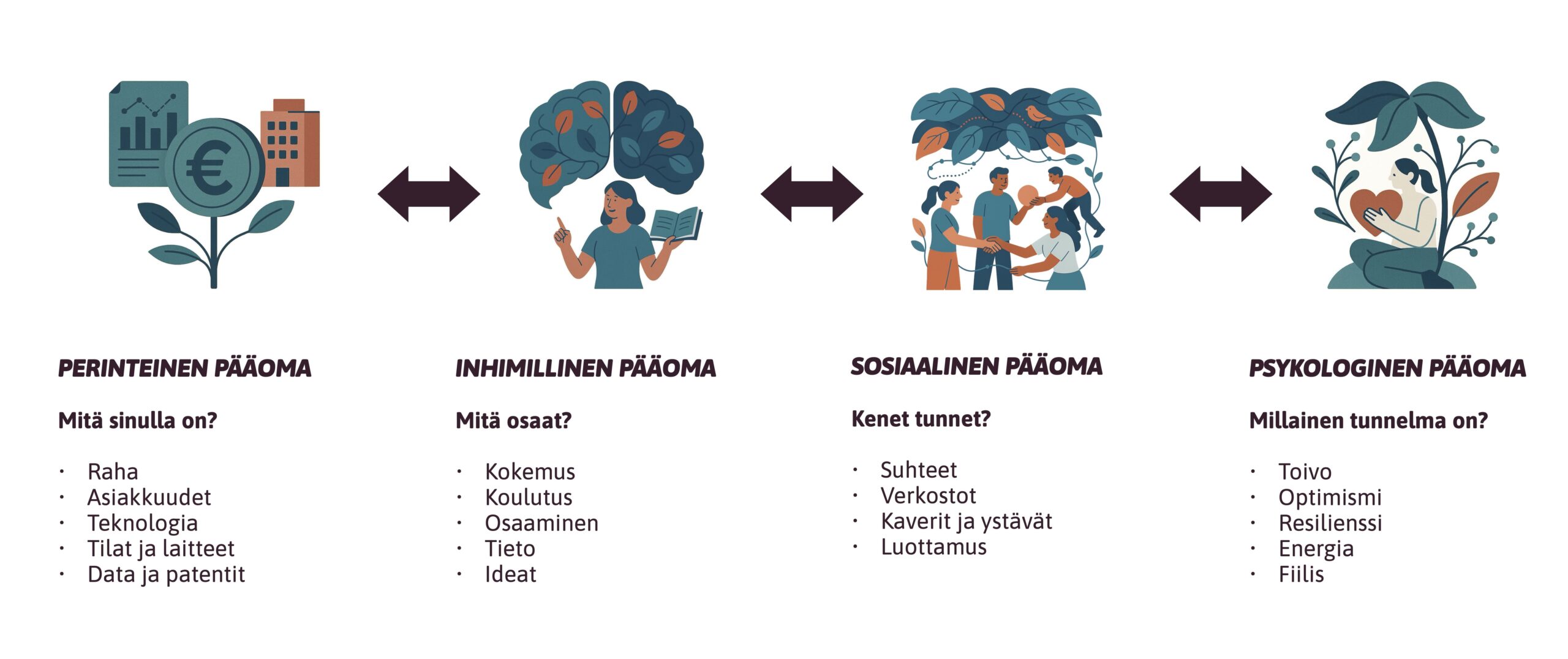
Social capital acts as a lubricant that opens doors to collaboration, markets, and funding even outside one’s own area. Funding does indeed come to good companies. Entrepreneurs located in rural areas face the challenge of lacking contacts and experience compared to clusters like Otaniemi.
Social capital rarely builds itself. Its emergence is supported by community builders, or community managers. Community management is a tool for creating connections, strengthening trust, and generating shared activities. It transforms networks and spaces into functioning communities. Without this invisible infrastructure, new knowledge and ideas are easily left unutilized. All functioning startup ecosystems have several community managers, but unfortunately, they often do this important work without an official role or recognition, alongside other tasks and part-time.

The ecosystem is like a sales funnel, wide at the top and narrow at the bottom
The services and actors of the startup ecosystem are dependent on each other. In the early stages, a lot of enthusiasm, event participants, and ideas are needed, from which emerge idea-stage companies, active startups, and eventually a few growth companies.
1) Mindset – building a culture: The first phase lays the foundation. There is a need for a local community and activities that provide information, inspiration, and lower the threshold for entrepreneurship. Everyone participates in the work – from individuals to organizations, educational institutions, municipalities, and businesses.
This phase is an ongoing effort. If the results are satisfactory and the activities are halted, the impact will eventually be seen in the number of startups.
🔍 Dozens of events, courses, and other content are needed to keep the wheel turning. 100 idea-phase companies mean thousands of people involved in this phase’s activities.
2) Pre-startup – idea phase: At this stage, hackathons, pre-accelerator activities, and other environments are needed where ideas take shape and teams can start building and testing things.
🔍 To create 30 new startups, about 100 quality idea-phase launches are needed.
3) Startup – supporting active startups: Now we are dealing with functioning companies. Services can include coaching, funding programs, solutions supporting internationalization, or coworking communities. It is important to consider what can be implemented in collaboration nationally or internationally, as the number of companies locally may be surprisingly small. The activities are targeted and need-based. Especially early-stage startups need peer support, while more advanced ones require targeted measures.
🔍 For example, in Tampere, 30 startups emerging annually means over 200 startups in the city. Common needs include finding customers, international go-to-market activities, and funding.
4) Scaleup – growth phase: Rapid expansion into international markets and large funding rounds characterize this phase. Essentially, the services and programs at this stage are location-independent. How do local services and social capital connect to these opportunities?
🔍 Many publicly visible companies labeled as “startups,” such as Oura, Wolt, ICEYE, IQM, Silo AI, and Supercell, are actually scaleups.
How can you act?
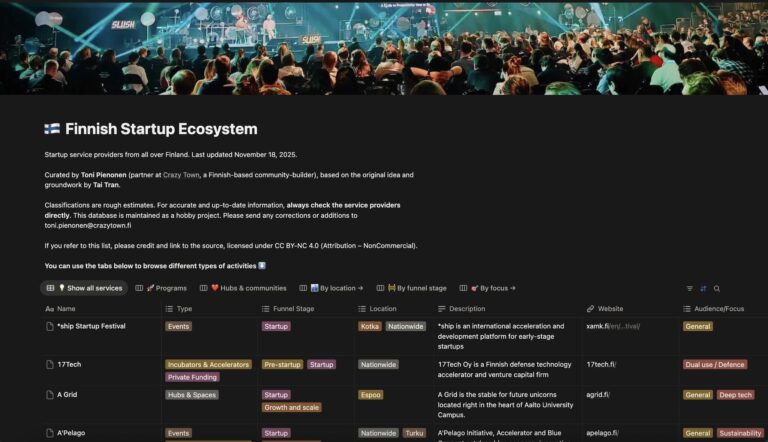
If you are an entrepreneur, start gathering other enthusiastic individuals around you. Participate in programs or seek help outside your hometown if you happen to be located in a smaller municipality. Many of them are open regardless of the city. For example, check out this list of Finnish service providers. Don’t stay alone. Build social capital. And if you happen to be in a city where CT operates, join us or bring your team members to us.
If you are a regional developer, higher education institution, or similar entity. Start building social capital. Create a community within the ecosystem that aims to serve entrepreneurs and focus on helping them. Include everyone who is willing. Don’t lead with assumptions or hopes. You can also utilize Crazy Town’s consulting assistance. We have been running entrepreneurial communities for over 20 years.
Get in touch, let’s build a functional, vibrant, and community-driven startup ecosystem together.
– Toni Pienonen, Crazy Town