The word startup appears almost everywhere. At events, startups buzz, they are constantly written about in articles, and many companies present themselves as startups. However, the trendy term remains unclear to many. What on earth does it actually mean? Is a startup just a new company? A small team? A firm looking for investors?
Startup is a term often thrown around assuming that everyone in the room (and on the other side of the screen) automatically understands what it means.
It’s no secret that at Crazy Town we hear a lot about startups. In “trendy” and modern coworking spaces, there are often startup companies among the members. Also, in various company pitch talks, growth programs, and funding applications, there are terms that are not clear to the average person. And heaven help us when the term is misused for a long time. Startup becomes an ambiguous label that means a little bit of everything and nothing at all.

What does startup really mean
In its simplest form, a startup is a young (0-10 years old) company that is growth-oriented and is still looking for a repeatable and scalable business model. The solution of a startup should be innovative and unique. For example, a consulting firm advising on the use of American software is not a startup.
A startup seeks external growth funding or is interesting from an investor’s perspective. However, this is not a requirement. The company’s willingness to grow and its stage are more important.
Often, a startup company has not yet necessarily defined its customer base, what added value it provides, or how its operations can be significantly scaled. A startup does not yet implement a ready model, but tests, learns, and changes direction if necessary. This is precisely what makes it a startup.
“A startup does not yet implement a ready model, but tests, learns, and changes direction if necessary.”
This is difficult for many to grasp. A startup does not mean a small company, nor does it mean a new company. Even if a company is small, it is not automatically a startup. A company can also be several years old and still be a startup.
When is a company no longer a startup?
A company is no longer a startup when it has enough age (10 years is a good upper limit). We know several excellent companies that started with rapid growth goals but have ended up on the path of traditional business. From the perspective of society and the entrepreneur, this is also an excellent outcome.
Rapidly grown companies that started as startups, such as ICEYE, Oura, or Kempower, are no longer startups but scale-ups.
The same applies to growth companies that have made an exit, such as Wolt and Supercell. They can be considered “startup-originated companies.” An exit refers to a situation, where the founders and original investors of the company sell their ownership through a business acquisition or go public. It is like the endpoint of the startup journey or the beginning of a new chapter.
According to definitions based on numbers, one way is also to consider the definition of “startup” through learning. When a company knows who to sell to, what to sell, and how to grow its operations, one can say that the company has moved from “startup” to the next more mature phase.
At this stage, the company can still grow rapidly and innovate, but it is no longer seeking answers to the fundamental question of whether the business works at all. It is already implementing a functioning model.
Ultimately, in the startup phase, value is not in the current state but in the potential. A company can still be small, unfinished, and even chaotic, but if it has the opportunity to solve a problem in a way that scales widely, it is a startup.
Uncertainty at this stage is not a weakness but an essential part of the process. Without it, there is no learning or sustainable growth.
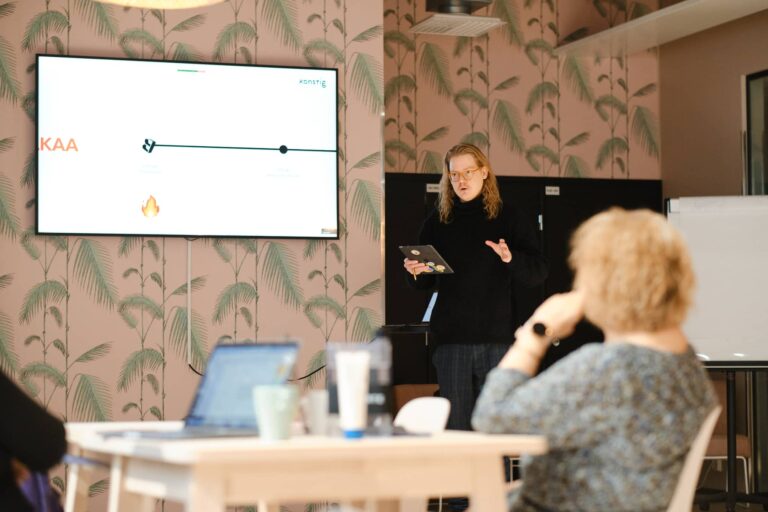
Example: why Crazy Town is not a startup
Crazy Town is often mentioned in the startup context because it operates around startups and growth companies on a daily basis. Yet, Crazy Town is not a startup.
In addition to being nearly a quarter of a century old, our business model is already established, our services are clear, and our operations are repeatable. We know what works, and we focus on implementing and developing a functioning whole. This does not make us worse or better, but simply a company at a different stage.
We are still eager to grow and develop. We experiment and develop new scalable services. We seek various growth funding options and are interested in discussions with investors.
“Growth is inherently related to startups, but it is not an end in itself.”
Growth is inherently related to startups, but it is not an end in itself. Growth is a result of the solution working and the market responding to it. It cannot be forced.
One of the most persistent myths is the idea that a startup means investment money. The term “bootstrapping” used in startup jargon refers to growing a company with customer funds and the entrepreneur’s savings, without external investors. The entrepreneur can then say they have grown the startup “organically” – in other words, by making sales.
To sum up: A startup can be a startup without a single euro of external funding, and on the other hand, an invested company can already be fully operational and no longer a startup at all.
Check out the startup funding dictionary angel investor on Ali Omar’s website.
The most important thing to remember about startups
A startup is not the same as a new company. A new company can be ready and operational right away. A startup is intentionally unfinished.
When this is understood, startup discussions become significantly clearer. At the same time, expectations, support, and discussions are placed on a more realistic basis – for both entrepreneurs and those observing the phenomenon from the sidelines.