This text was written by Elina Tapio, a member of Crazy Town in Jyväskylä. Elina from Raami Development Services Ltd is an expert in language, interaction, accessibility, and development methods, with solid pedagogical expertise.
The body language course “Body Gestures” was conducted in the expert community of Crazy Town in Jyväskylä. The series of five meetings provided participants with a new way to understand bodily communication: not from the perspective of myths, but from the research of interaction and everyday situations. The course enhanced participants’ awareness of gestures, increased their confidence in using them, and supported more impactful and inclusive expert communication.
Crazy Town is a coworking network that offers spaces for work and community learning and business development in several locations. The membership of Crazy Town consists of entrepreneurs, experts, sales and marketing professionals, and individuals working in internal development roles within companies. Elina from Raami has been a member of Crazy Town since 2023. The pilot of the Body Gestures course was a perfect fit for Crazy Town, where communication, presentation, and interaction skills are the foundation for many other activities.

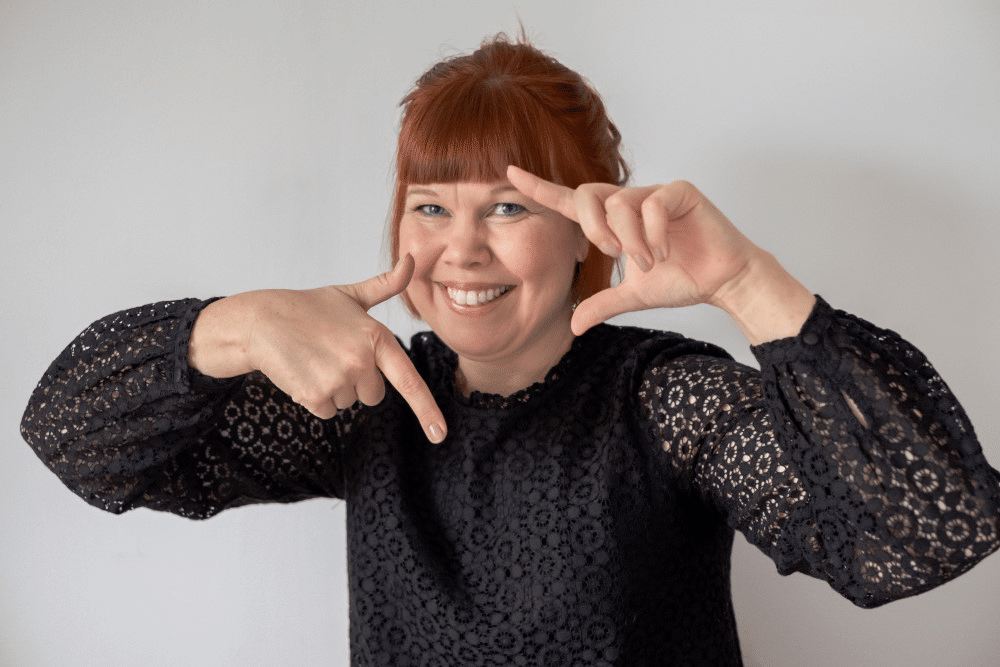
The gesture in the image, with thumbs extending outward from crossed hands, can be a significant element in a conversation. Image: Outi Pippuri.
The need to strengthen communication without body language myths
The Body Language course was attended by six members of Crazy Town and one external participant, who had identified the need to enhance their communication skills in a way that does not rely on simplistic “body language interpretation guides,” but rather on interdisciplinary research and practical exercises. In the first meeting, we reviewed common myths related to body language and interaction. These include the familiar claim that 93% (the percentage varies in different quotes) of understanding is based on nonverbal communication. This claim is well-known among researchers in the field as the ‘zombie myth’. Of course, we debunked the myths and misconceptions with the latest research findings in the field.
As highlighted by the feedback from Inka Hyvönen below, we recognized at the beginning of the course how prevailing perceptions guided the participants’ bodily expression. These beliefs, perceptions, and their validity sparked lively discussion in the first meeting of the course.
“During and after the course, I have paid more attention to my own and others’ use of gestures. On a personal level, I have sometimes wondered if I gesture (essentially wave my arms) too much, but during the course, my thoughts shifted more towards the idea that it might be good to hold on to my natural style and refine the nuances through awareness and consider what kinds of gestures to use.”
– Inka Hyvönen, Account Manager
The goals of the course were formulated together. Participants wanted to:
- increase awareness of their own bodily communication
- understand what gestures can do (not just what they “reveal”)
- strengthen presentation skills, employee onboarding, and client work
- find ways to support understanding and participation
- learn to utilize gestures in explaining challenging or abstract topics
- discover their own personal and brand-consistent way of using gestures.

Gestures are much more than emblems, that is, symbolic gestures, to which many myths debunked in the course were related. Image: Akshay Gupta.
Practical training and research-based insights into bodily interaction
The course included five intensive meetings (a total of about 7 hours). The content and methods draw from multiple knowledge bases due to Elina’s background:
- ethnographic research
- multimodal interaction research
- sign language research and
- traditions and pedagogical foundations of sign language teaching.
The course’s atypical approach is encapsulated in the slogan: less babbling, more practicing expression in the body. Since one of the fundamental goals of the course was to shift attention from spoken language to bodily communication, we practiced bodily and visual communication in such a radical way as committing to silence for certain exercises.
For example, one meeting aimed to learn how to utilize gestures in onboarding and giving instructions. This was practiced completely silently in pair tasks: participants had to guide each other using gestures without speech or vocalizations in various typical office tasks.
In this way, participants noticed that they could understand and be understood solely by using gestures, expressions, eye contact, etc., in situations where they had not believed this to be possible.
Here are examples of the course themes that had the greatest impact on participants:
1. Classification and observation of gestures
Participants learned to identify different types of gestures: pointing, representational, metaphorical, symbolic, and rhythmic gestures, and practiced producing and observing them in various situations.
2. Supporting abstract and complex messages with gestures
Utilizing gestures to explain schedules, workflows, or interconnected abstract structures (e.g., in a project plan presentation or speaker engagement).
3. Bodily communication in expressing empathy
Empathetic listening to “pain stories,” mirroring gestures, and building psychological safety through bodily expression.
4. Building one’s own gesture vocabulary
At the end of the course, participants created a personal “gesture vocabulary” that included bodily means that support their own work role, brand, and communication goals.
Participants became aware of their gestures in a new way and now consciously utilize bodily expression
The course provided participants with both concrete skills and a deeper awareness of the multimodality of interaction. Based on feedback:
- 100% of participants found the course impactful and beneficial.
- Participants began to pay more attention to both their own and others’ gestures.
- Participants reported that they utilized the lessons immediately in client work, presentations, or internal team communication.
- After the course, participants reported gaining more courage to use gestures, the ability to observe others’ expressions more closely, new ways to explain complex or abstract matters, and discovering their own and brand-aligned bodily expression.
How did the change feel?
Participants felt they were on the brink of something new. The strong research-based foundation of the course inspired the participants. Traditional body language coaching often emphasizes presentation skills, whereas this course focused on interpersonal interaction – reciprocity and encounters.
The pedagogical solutions used in the course exercises brought joy and a strong sense of community to the group in addition to learning. The members of Crazy Town were also a significant ingredient in the success of the course, as Anna Sorko (Bondauttaja Oy) highlighted in her feedback: “Elina’s skilled and multi-layered guidance, along with the support of a diverse group, were a big part of the course’s success.”
“I learned above all how significant gestures are in interaction. I learned to pay more attention to both my own gestures and those used by others. I learned to reinforce the gestures in my expert work that facilitate goal-oriented communication and interaction.” – Päivi Luoma, CEO, Intotalo Oy
“The greatest benefit was becoming aware of my own and others’ gestures, learning different ways to utilize gestures, and practicing these in real life. Additionally, I started to create my own type of ‘gesture language’ that particularly helps in building my personal brand and more impactful expert communication.” – Anna Sorko, community-driven coach
“The course awakened me to the importance of gestures and body language, and how by refining my own gesturing I can enhance my message. On a practical level, I have asked both my clients and colleagues to keep their cameras on during video meetings. This improves contact and presence in meetings.” – Pasi Isomäki, account manager, Trustmary
“Since taking the course, I have started to use gestures much more actively as part of my expression. Addressing different types of gestures increased my understanding of what can be done with gestures. I have also begun to pay more attention to the gesturing of others.” – Janne Kröger, doctoral researcher
Body Language Course to Support Your Expert Communication?
Do you want to strengthen your team’s or organization’s interaction, expert communication, and presentation impact?
👉 Order the Body Movements course tailored for your team for example for sales, customer service, managers, or professionals. Check out the detailed content and training promise of the Body Movements course.