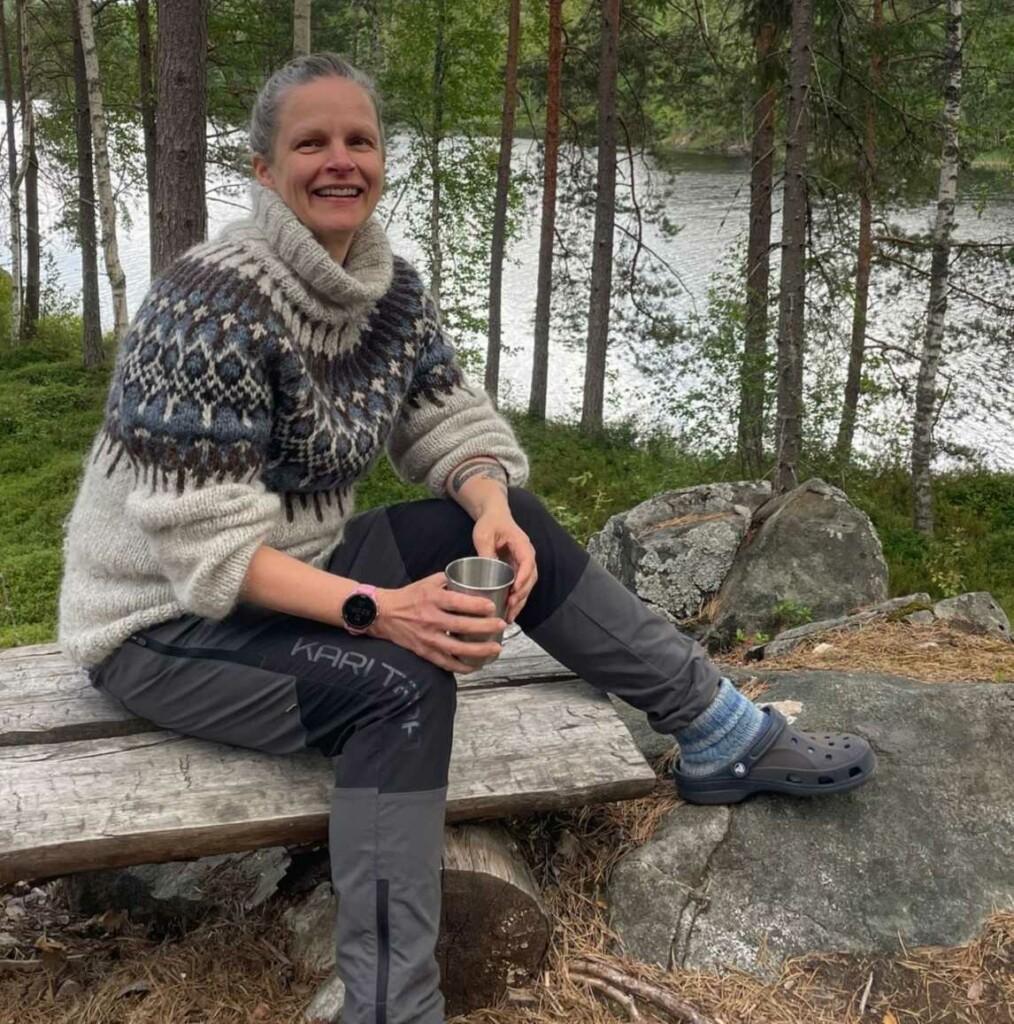
The text is written by Tiina Hoskari from Jyväskylä. Hoskari has worked as a mental and performance coach for athletes and ultrarunners. She is passionate about the health benefits of forests, holistic coaching, and the development of coaching and wellness issues.
What on earth is alertness?
”Alertness refers to a person’s level of vigor and awareness. The ability to recognize and regulate one’s own alertness enhances both mental and physical well-being. It is common for alertness to vary throughout the day. Many different factors affect alertness, such as the amount and quality of sleep, emotions, the amount of light, and the time of day. For example, after a poorly slept night, your alertness may be very low in the afternoon. On the other hand, when you get excited about something or feel anxious, your alertness rises higher than when you are doing ordinary tasks. When alertness is balanced, neither too high nor too low, a person is in an appropriate state of alertness. An appropriate state of alertness facilitates learning new things, focusing on the present moment, and maintaining good functionality.” (Mieli ry, 2024)
We often encounter situations where alertness is not ideal. Life sometimes presents more challenges than recovery. Conditions change. Each person’s own biorhythm (sleep and eating patterns as well as physical activity) also affects alertness. Take a moment for yourself and learn to regulate your alertness. It is a good first aid for many situations and also helps positively with the feeling of stress management.
What factors contribute to the best state of alertness?
Researching the best results of top athletes has shown that the following factors have influenced the outcome:
- calmness of mind
- feeling of physical relaxation
- strong self-confidence
- deep focus on performance
- feeling of strength and energy
- management of mind and stress feelings
- closing out the external environment from awareness (Liukkonen, p. 59).
The same can be utilized at work as well. To achieve a FLOW state, challenges and skills must be balanced. The state of alertness also affects the FLOW state. Alertness influences how well you can concentrate on ongoing and upcoming tasks. MWhat factors weaken your own concentration?
What weakens alertness?
Concentration can be weakened by:
- fatigue
- feeling of hunger and thirst
- temperature (too hot or too cold)
- irregular circadian rhythm
- stress
- noise
- lighting (it can be too bright or too dark)
- motivation and enthusiasm, especially if they go too high
- uncertainty due to inexperience
- lack of preparation
- excitement
- new environment or new tasks
- odors
- focusing on the irrelevant (e.g., inappropriate surfing on social media)
- too high arousal level (e.g., performance anxiety before a presentation)
What level is your arousal at this moment? And generally? What would you like it to be like?
“The most common challenge is that the arousal level rises too high, and the individual cannot function optimally.” (Tossavainen & Peltonen, p. 263). People are often unknowingly in a state of over-arousal.
How to recognize over-arousal?
- difficulties in relaxing or calming down
- sleep difficulties
- digestive symptoms (e.g., bloating in the stomach, diarrhea, gas regardless of what and how you eat, increased need to urinate)
- decreased stress tolerance
- restlessness
- difficulties in concentrating
- muscle tension (e.g., tightening of facial muscles, tension in the neck and shoulder area)
- cognitive challenges (irritability, difficulties in self-regulation, irritability, etc.)
- heart rate is high
- you make poor choices
Learn primarily to lower your arousal level. It is harder than raising it. Lowering also helps with the feeling of stress management.
How to lower arousal level?
- count your breathing rhythm
- act calmly
- consciously speed up your breathing rhythm
- act energetically
- use positive and powerful words and phrases, such as: I can do this! Go!
- growl and roar like a lion
- drum or pat your body
- listen to energizing music
- create energizing imagery
- listen to inspiring music
- do energizing physical exercise (e.g., push-ups, jumps, general movement burpees, short quick sprints, hop up the stairs)
- seek an energizing environment and try to draw energy from it
EXERCISE: Choose 1-3 methods and try them out. What works best for the current situation?
SOURCES: Liukkonen, Jarmo. 2020. Psychological Strength. PS-kustannus. Tossavainen, Aleksi & Peltonen, Antti. 2023. Peltonen Performance. Mieli ry, reference 7.6.2024 https://www.mielenterveysseurat.fi/
Tiina Hoskari LinkedIn
valmentaja.hoskari@gmail.com
tel. 044 214 5815