This text was written by Anni Karjalainen from Crazy Town Jyväskylä. Anni is a word-savvy content marketer who masters various concepts and formats, but also delves into the intricacies of advertising in B2B marketing agency MIAMI Agency‘s accounts.

Social media has represented very different things for B2B companies over the years: it has been a necessary evil, a communication channel, and a platform where presence is more of a formality than a strategic choice. We are now at a point where it is no longer enough to acknowledge the power of social media in B2B marketing – it is now essential to be relevant and provide content that is credible specifically in social media channels.
Social media is still a channel for many B2B companies to share other content rather than being at the center of the entire content strategy. There is fundamentally nothing wrong with sharing content on social media – it is an effective channel for content distribution, but in this context, it is often forgotten that content no longer fits social media in any form other than as a social media post.
It is therefore high time to accept that a credible social media presence is not built by sharing links to articles. B2B companies still produce better content, which, however, does not reflect in social media posts. We often compare a social media follower to a newsletter subscriber, as they have equally chosen to follow your company’s content as to subscribe to your newsletter. So why not create content purposefully and in a form that can also be consumed on social media?
Social first strengthens trust, thus building a competitive advantage
Social first is a kind of shift in thinking, and its purpose is to shift the focus of the content strategy to support the power of social media. Organic content and advertising work best when they are credible in the channel where they are published.
Social media is a perfect place for B2B marketing to engage and build trust, which is one of the most important tasks of marketing due to long buying journeys. It is also possible to build thought leadership – or niche fame – or a winning employer brand that creates an advantage in recruitment situations.
On the side of prioritizing social media, there is also dark social, which maximizes the impact of individual posts. This is particularly common in B2B marketing, where fewer and fewer individuals want to share corporate content publicly. Sharing is more likely to happen through private channels, i.e., on the dark social side.
Social first in practice – where to start?
The social first mindset requires, above all, a conscious change in how content is planned and shared. It means that content is no longer produced just for websites and shared as links on social media – it is about designing and producing content primarily for social media in the formats and forms that the audience is ready to consume. This includes zero-click content, which aims to engage the audience without directing them away from the platform.
The traditional way of sharing links on social media and waiting for a traffic spike to the website is no longer sufficient, as users are spending more and more time on social media platforms without moving away from them. For this reason, content that works specifically on social media – whether it is summarized information, a discussion-provoking post, or a visual summary – has a greater impact.
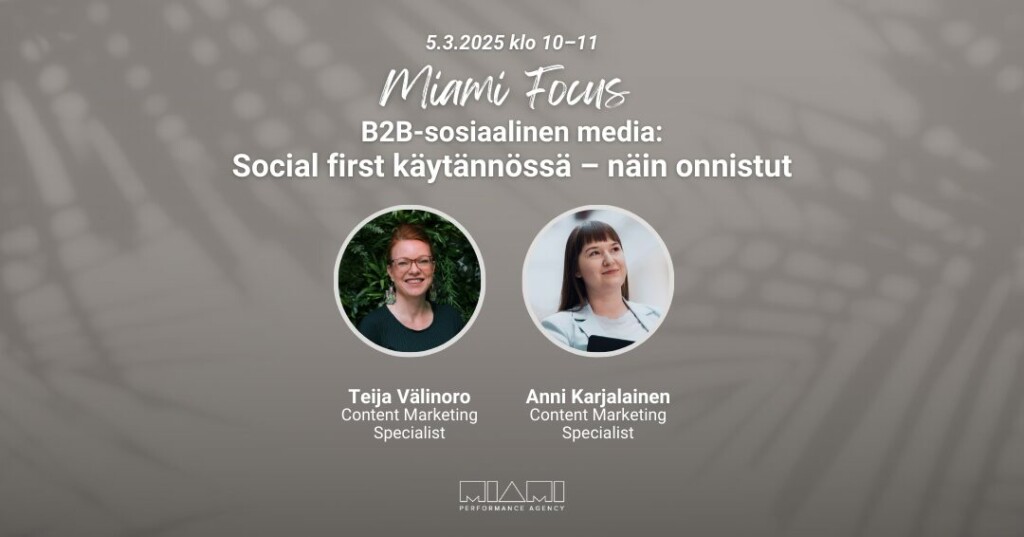
Do you want to hear more about how social first is integrated into content strategy and put into practice? My colleague and I will delve into the social first mindset in the next Miami Focus webinar on March 5, 2025 – register now! The webinar is free, and all registrants will automatically receive a recording.